
A metal detector is an electronic device that detects the presence of metal nearby. It works by using electromagnetic fields to sense metal objects—either on or below the ground or hidden inside other materials.
Special Thanks to Our Sponser – JLCPCB:
No project is complete without the right tool and materials. That’s why our sponser JLCPCB stepped into provide essential material for the project. JLCPCB is a leading provider of high quality printed circuit board and PCB assembling services.
Simply head over to JLCPCB, Upload your gerber file, select specification and just place your order.
48-Hour Turnaround for 6 Layer PCBs!

$0 for 2u” ENIG. Free Via-in-Pad. High Precision. Sign Up to Get $80 New User Coupons.

How To Order PCB
48-Hour Turnaround for 6 Layer PCBs!
Discover Easy, Affordable, and Reliable PCB manufacturing with JLCPCB! Register to get $60 New customer coupons.
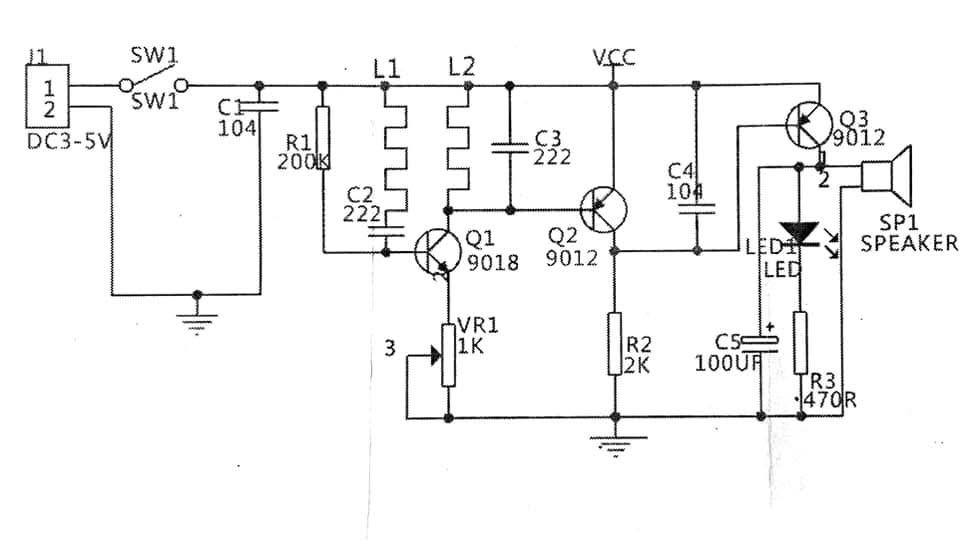
Circuit Diagram:
9012 Transistor:
The 9012 transistor is a complementary PNP transistor to the 9014 NPN transistor. It’s used in similar low-power, general-purpose applications like switching and amplification in electronic circuits, especially in push-pull amplifier configurations when paired with the 9014.
🔍 9012 Transistor: Technical Specifications
| Parameter | Value |
|---|---|
| Type | PNP |
| Collector-Emitter Voltage (Vce) | -40V |
| Collector-Base Voltage (Vcb) | -50V |
| Emitter-Base Voltage (Veb) | -5V |
| Collector Current (Ic) | -800 mA |
| Power Dissipation (Ptot) | 625 mW |
| DC Current Gain (hFE) | 64 – 400 |
| Transition Frequency (fT) | 250 MHz |
| Package Type | TO-92 |
📦 Pin Configuration (TO-92 package)
Looking at the flat side of the TO-92 package with the pins facing down:
- Emitter (E) – Left
- Base (B) – Middle
- Collector (C) – Right
⚙️ Operating Regions (for PNP)
- Cut-off (OFF): Base voltage is more positive than emitter → no current flows.
- Active (Amplification): Base is slightly negative relative to emitter → collector current is proportional to base current.
- Saturation (ON/Switching): Base is much more negative than emitter → maximum current flows.
🛠️ Typical Uses
Hobby electronics.
Audio amplifiers (often with 9014)
Switching small loads
Complementary circuits (push-pull stages)
More Projects
-

Building an Automatic Dark Sensor with BD139 Transistor
Light and darkness are two sides of the same coin, influencing our daily lives in ways we often overlook. Imagine a world where lights adjust themselves according to the ambient light—a realm where darkness triggers illumination automatically. Such a world isn’t far-fetched, and with the BD139 transistor, creating an automatic dark sensor becomes an exciting…
-

Servo Motor Controller Circuit
A servo motor controller circuit is an electronic system designed to control the position, speed, and direction of a servo motor. Servo motors are used in various applications, including robotics, automation, and precision control systems. The controller circuit typically receives control signals (often from a microcontroller or external controller) and adjusts the servo motor’s movement…
-

Amazing LED Chaser Circuit – Beautiful Decoration Idea
An LED chaser is an electronic circuit that lights LEDs one after another in a sequence. It creates a running or chasing light effect commonly seen in decorations and indicators. The sequence can move left-to-right, right-to-left, or in patterns. It’s usually built using ICs like 555 timer + 4017 decade counter. Components Required: Circuit Diagram:…